
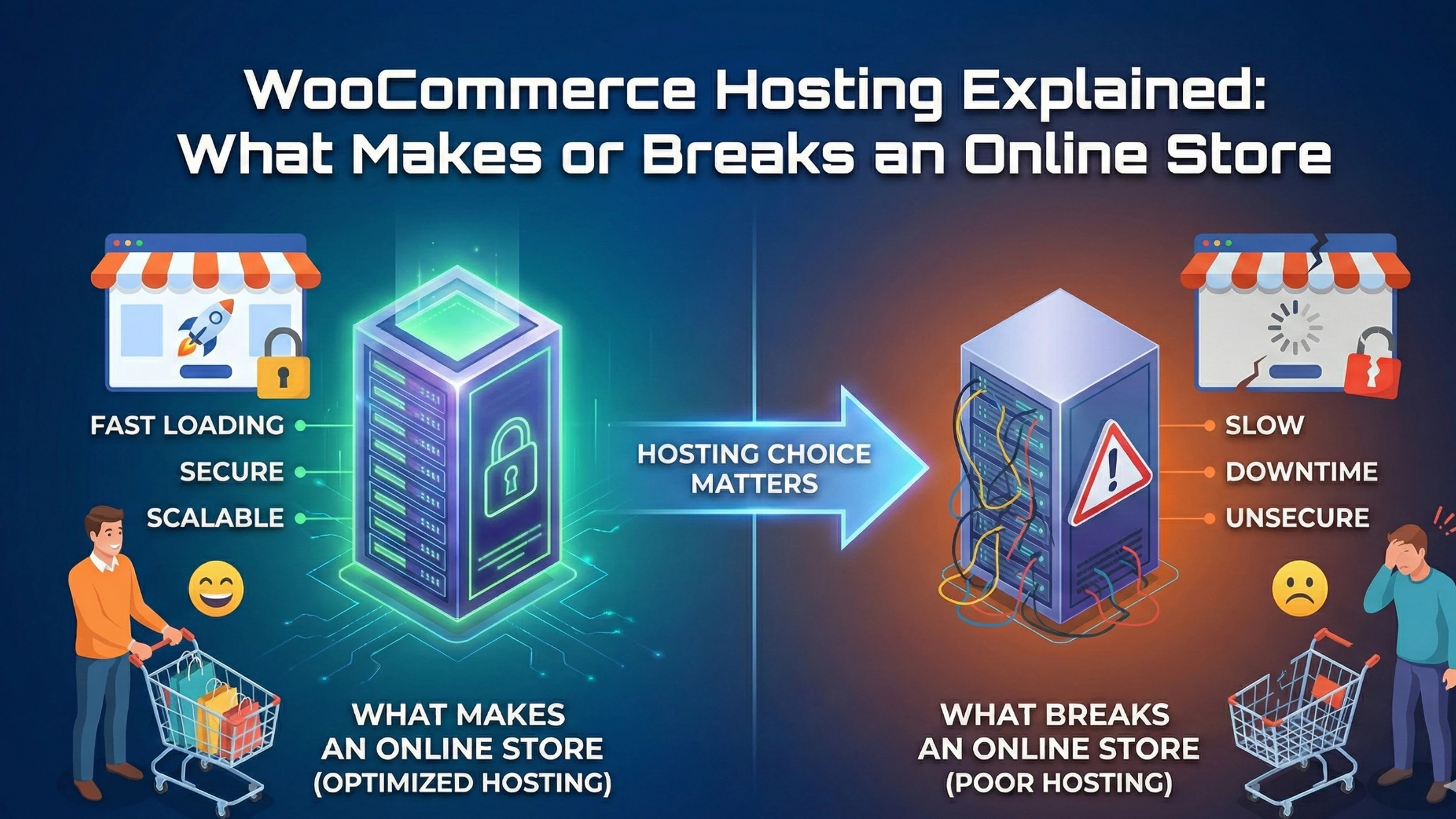
Starting an online store feels exciting. You pick products, design your website, set prices, and imagine orders rolling in. But once the store goes live, reality hits. Pages load slowly. Checkout feels laggy. Customers abandon carts for reasons you can’t fully explain.
In many cases, the problem isn’t your product, pricing, or marketing.
It’s your hosting.
WooCommerce websites are very different from normal websites. They are dynamic, resource-heavy, and sensitive to performance issues. This guide explains why WooCommerce hosting matters, what makes it different, and how the right hosting setup can directly affect sales, trust, and long-term growth.
Why WooCommerce Websites Are More Demanding
A regular website mostly shows content. A WooCommerce store constantly performs background operations such as:
- Managing product databases
- Handling user sessions
- Processing carts and checkouts
- Running payment gateways
- Updating inventory in real time
Each of these actions consumes server resources. On poorly optimized hosting, these processes slow each other down.
That’s why many WooCommerce stores struggle even when traffic is not very high.
The Hidden Cost of Slow WooCommerce Hosting
Slow performance doesn’t just annoy users — it costs money.
When a WooCommerce store is slow:
- Customers lose trust
- Checkout abandonment increases
- Payment failures happen
- Search rankings drop
Even a one-second delay can significantly reduce conversions. Many store owners spend money on ads while ignoring hosting, unknowingly wasting their marketing budget.
What Is WooCommerce Hosting (Simple Explanation)
WooCommerce hosting is hosting that is optimized specifically for running WooCommerce stores.
Instead of treating your store like a normal website, the server environment is tuned for:
- Database-heavy operations
- Cart and checkout performance
- Product filtering and search
- Secure payment processing
You can see how this works with
👉 WooCommerce Hosting
https://vidohost.com/woocommerce-hosting
(Internal Link 1/3)
Why Regular Hosting Fails WooCommerce Stores
Many WooCommerce stores start on basic hosting because it’s cheap and easy. At first, it works. But as products increase and traffic grows, problems appear.
Common issues with regular hosting:
- Limited server resources
- No WooCommerce-specific caching
- Weak database optimization
- Generic security rules
WooCommerce doesn’t fail suddenly — it slowly becomes unreliable.
Speed Is Everything for Online Stores
Speed affects every part of the shopping experience:
- Product page loading
- Cart updates
- Checkout processing
- Order confirmation
WooCommerce hosting improves speed by:
- Optimizing database queries
- Reducing server response time
- Handling traffic spikes better
Speed is not a technical luxury — it’s a sales tool.
Security Is Critical for WooCommerce
Online stores handle sensitive customer data. This makes security non-negotiable.
WooCommerce-focused hosting improves security by:
- Protecting payment processes
- Reducing vulnerability exposure
- Preventing common attack patterns
- Supporting SSL and secure transactions
A single security incident can permanently damage customer trust.
WooCommerce Hosting vs WordPress Hosting
Many people assume WooCommerce hosting and WordPress hosting are the same. They’re related — but not identical.
WordPress hosting focuses on:
- Content performance
- Plugin stability
- Publishing efficiency
WooCommerce hosting adds:
- Transaction handling
- Cart performance
- Inventory stability
If your site is content-only, optimized WordPress hosting may be enough. For stores, WooCommerce hosting becomes necessary.
You can compare this with
👉 WordPress Hosting
https://vidohost.com/wordpress-hosting
(Internal Link 2/3)
Handling Traffic Spikes Without Crashing
Sales campaigns, ads, or festive seasons can bring sudden traffic spikes. Poor hosting collapses under pressure.
WooCommerce hosting is designed to:
- Handle concurrent users
- Maintain checkout stability
- Prevent timeouts during peak traffic
Stores that fail during peak demand often lose customers permanently.
When WooCommerce Stores Need More Power
As your store grows, hosting requirements change.
You may outgrow basic hosting when:
- Products exceed hundreds
- Daily visitors increase
- Order volume rises
- Custom features are added
At this stage, scalable infrastructure becomes important.
For high-growth stores, upgrading infrastructure is often easier than fixing performance problems later.
Migrating a WooCommerce Store Safely
Migration fear is common — and understandable. Broken carts, missing orders, or downtime can be disastrous.
That’s why professional migration matters.
VidoHost offers
👉 Free Website Migration
https://vidohost.com/free-migration
(Internal Link 3/3)
This ensures your store moves safely without data loss or checkout issues.
What Most Store Owners Learn Too Late
Many WooCommerce store owners spend months:
- Optimizing images
- Tweaking themes
- Installing caching plugins
But none of these fix a weak hosting foundation.
Hosting is not something you “optimize around.”
It’s something you build on.
When WooCommerce Hosting Is Worth It
WooCommerce hosting is worth it if:
- Your store generates revenue
- Performance affects sales
- You care about long-term growth
- Customer trust matters
For serious online stores, hosting is not an expense — it’s infrastructure.
Final Thoughts
WooCommerce is powerful, but it demands the right environment to perform well. Regular hosting might get you started, but it rarely supports sustainable growth.
The right WooCommerce hosting keeps your store fast, secure, and reliable — even as traffic and orders increase.
If your store matters to you, your hosting choice should reflect that.