
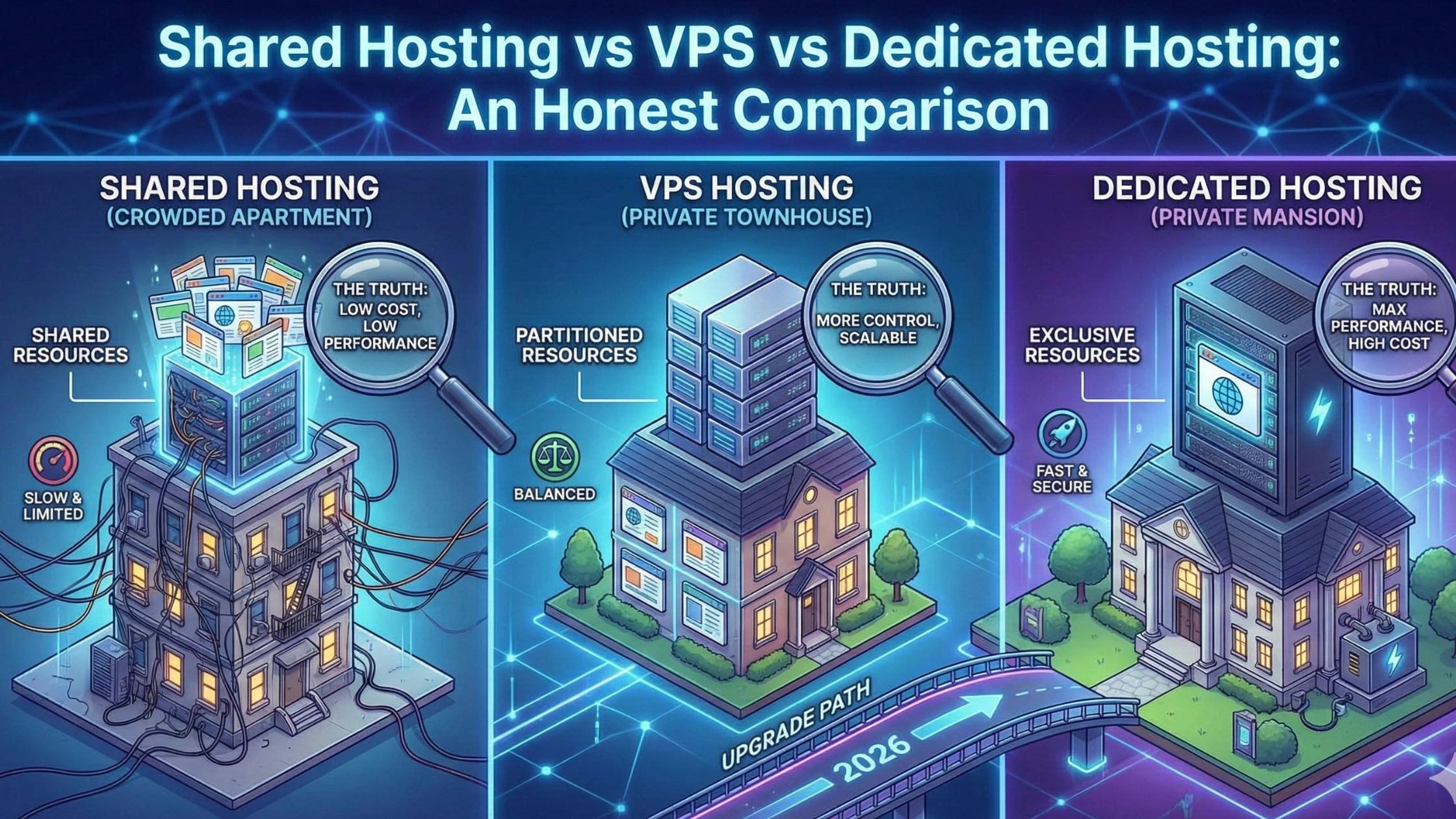
Choosing web hosting often feels harder than building the website itself. Shared hosting, VPS hosting, dedicated servers—each option promises better performance, speed, and reliability. But most explanations online are either overly technical or heavily biased toward selling the most expensive plan.
This guide is different.
Instead of pushing you toward a specific option, this article explains when each hosting type actually makes sense, based on real website needs, not marketing hype.
If you’re confused about which hosting is right for you, this comparison will clear it up—honestly and practically.
Why Hosting Choice Matters More Than People Think
Hosting isn’t just about storing files. It affects:
- Website speed
- Uptime and reliability
- Security
- SEO performance
- User experience
A powerful website on weak hosting struggles. A simple website on the right hosting performs smoothly.
The goal is not to buy “the best hosting,” but to buy the right hosting for your current stage.
What Shared Hosting Really Is
Shared hosting means multiple websites share the same server and its resources.
It exists for one reason: affordability.
Where Shared Hosting Works Well
Shared hosting is ideal when:
- You’re launching a new website
- Traffic is low or unpredictable
- You’re running a blog or basic business site
- Budget efficiency matters
Many websites run perfectly fine on shared hosting for years.
You can see typical beginner-friendly setups on
👉 Website Hosting
https://vidohost.com/website-hosting
(Internal Link 1/3)
The Real Limitations of Shared Hosting
Shared hosting has limits, and they’re important to understand.
Common issues include:
- Slower speed during peak hours
- Limited server resources
- Performance affected by other websites
- Restricted customization
These limitations don’t mean shared hosting is bad—it simply means it’s not designed for growth-heavy projects.
What VPS Hosting Actually Changes
VPS (Virtual Private Server) hosting creates a virtual partition inside a physical server. Your website gets dedicated resources, even though the server is shared at a hardware level.
This creates a major difference in stability and performance.
VPS Hosting Is Better When:
- Your traffic grows steadily
- You need more server control
- Your site uses more plugins or scripts
- Performance consistency matters
VPS hosting reduces the “neighbor effect” common in shared hosting.
VPS Hosting vs Shared Hosting: The Practical Difference
The difference is not always visible immediately, but it shows over time.
Shared hosting:
- Shares CPU and RAM dynamically
- Is affected by other users
- Has tighter limits
VPS hosting:
- Allocates fixed resources
- Offers predictable performance
- Handles traffic spikes better
For growing websites, VPS hosting often feels like a relief rather than an upgrade.
What Dedicated Hosting Really Offers
Dedicated hosting gives you an entire physical server exclusively for your website or application.
No sharing. No virtualization. Full control.
Dedicated Hosting Is Designed For:
- High-traffic websites
- Resource-heavy applications
- Businesses needing strict security
- Large ecommerce platforms
You can explore enterprise-grade environments on
👉 Dedicated Server Hosting
https://vidohost.com/dedicated-server-hosting
(Internal Link 2/3)
Why Dedicated Hosting Is Often Overkill
Dedicated hosting sounds impressive—but it’s not always necessary.
For many websites:
- Traffic doesn’t justify the cost
- Resources remain underused
- Management becomes complex
Dedicated hosting should be chosen because it’s required, not because it sounds powerful.
Hosting Comparison Based on Real Use Cases
Let’s look at practical scenarios.
Personal Blogs & Small Websites
Shared hosting is usually more than enough.
Business Websites
Shared hosting works initially. VPS hosting becomes useful as traffic grows.
Content-Heavy Platforms
VPS hosting provides stability and room to scale.
High-Traffic or Revenue-Driven Websites
Dedicated hosting ensures consistent performance and isolation.
Performance: What Most People Miss
Performance is not just about speed tests.
It includes:
- How the site behaves under load
- How it handles simultaneous users
- How stable it feels over time
Shared hosting struggles under pressure. VPS handles pressure better. Dedicated hosting eliminates pressure entirely.
Security Differences Between Hosting Types
Security improves as isolation increases.
Shared hosting:
- Shared environment risks
- Generic security rules
VPS hosting:
- Better isolation
- More customizable security
Dedicated hosting:
- Maximum isolation
- Full control over security policies
Security requirements vary by website type. Not every site needs enterprise-level protection.
Scalability: Thinking Ahead Without Overpaying
One of the biggest mistakes is buying hosting for a future that may not happen.
A smarter approach:
- Start with shared hosting
- Upgrade to VPS when needed
- Move to dedicated hosting only when required
This path avoids unnecessary expenses while keeping growth smooth.
Migration Between Hosting Types
Upgrading hosting doesn’t mean starting over.
Websites commonly move from:
- Shared → VPS
- VPS → Dedicated
What matters is how smoothly the migration is handled.
Services like
👉 Free Website Migration
https://vidohost.com/free-migration
(Internal Link 3/3)
exist to remove technical risk during upgrades.
Which Hosting Type Is Best for You?
Here’s the honest answer:
- If your website is new → Shared hosting
- If your website is growing → VPS hosting
- If your website is critical → Dedicated hosting
There is no single “best” option—only the best fit.
Final Thoughts
Hosting decisions should be based on needs, not noise.
Shared hosting is not weak. VPS hosting is not magic. Dedicated hosting is not mandatory.
Each serves a purpose. Understanding that purpose is what allows your website to grow confidently, without overspending or performance frustration.
Choose hosting that supports where your website is today—and allows it to move forward tomorrow.