
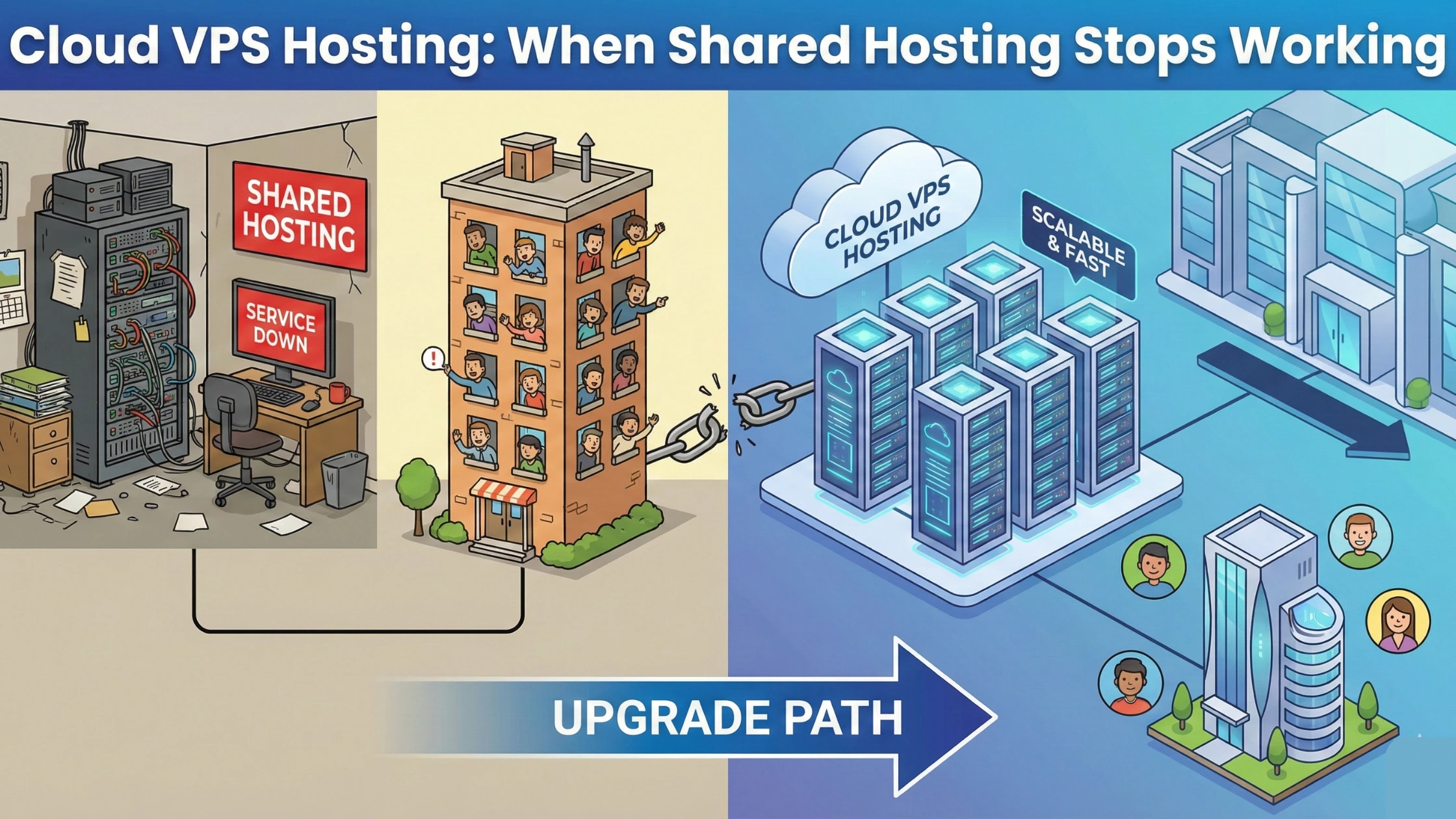
Shared hosting is where most websites begin—and for good reason. It’s affordable, simple, and requires almost no technical knowledge. For new blogs, small business sites, and early-stage projects, shared hosting often works just fine.
But at some point, many website owners hit a wall.
Pages start loading slowly for no clear reason. Traffic spikes cause temporary downtime. Simple updates suddenly break things. Support keeps saying, “You’ve reached your resource limit.”
That’s usually the moment when people first hear about cloud VPS hosting—often after frustration has already set in.
This guide explains, in plain language, what cloud VPS hosting really is, why shared hosting eventually stops working, and how to know when it’s time to upgrade—without overbuying or overcomplicating things.
Why Shared Hosting Works… Until It Doesn’t
Shared hosting is built on one simple idea:
many websites share one server to keep costs low.
When traffic is light and resource usage is minimal, this setup works surprisingly well. Most new websites don’t need much CPU power, memory, or database performance.
Problems appear when any of these increase:
- Traffic grows
- Content becomes heavier
- Plugins or scripts multiply
- Background tasks increase
Shared hosting doesn’t scale gracefully. It has hard limits, and once you reach them, performance drops instead of adjusting.
Common Warning Signs That Shared Hosting Is Holding You Back
Shared hosting rarely “fails” suddenly. Instead, it shows quiet warning signs that are easy to ignore at first.
Some of the most common signals include:
- Website slowing down during peak hours
- Random 503 or timeout errors
- Admin panel feeling laggy
- Updates taking longer than usual
- Support recommending upgrades repeatedly
If you recognize more than one of these, your website has likely outgrown shared hosting.
What Cloud VPS Hosting Actually Is (Without Jargon)
Cloud VPS hosting stands for Virtual Private Server hosted on cloud infrastructure.
Here’s what that means in practical terms:
- Your website gets dedicated resources (CPU, RAM, storage)
- Those resources are not affected by other websites
- The server environment is virtual, but isolated
- The “cloud” means it’s backed by multiple machines, not one
Unlike shared hosting, cloud VPS hosting doesn’t rely on leftover resources. Your website has guaranteed capacity.
You can explore this type of setup through
👉 Cloud VPS Hosting
https://vidohost.com/cloud-vps-hosting
(Internal Link 1/3)
Shared Hosting vs Cloud VPS: The Real Difference
The biggest difference isn’t price or features—it’s predictability.
Shared hosting:
- Resources fluctuate
- Performance depends on neighbors
- Limits are enforced strictly
Cloud VPS hosting:
- Resources are fixed and reserved
- Performance remains consistent
- Traffic spikes are handled better
For growing websites, predictability matters more than anything else.
Why “Cloud” Matters in VPS Hosting
Traditional VPS hosting often runs on a single physical server. If that server fails or overloads, your website is affected.
Cloud VPS hosting spreads workloads across multiple machines. This provides:
- Better uptime
- Improved redundancy
- Easier scaling
- Faster recovery from issues
This makes cloud VPS hosting more stable for business-critical websites.
Performance: The First Improvement You’ll Notice
Most people notice the performance difference almost immediately after moving to cloud VPS hosting.
Improvements usually include:
- Faster page load times
- Smoother admin experience
- More reliable background tasks
- Better handling of simultaneous users
Speed improvements don’t come from magic—they come from having enough resources at all times.
Cloud VPS Hosting for Content & Business Websites
Content-heavy websites and business sites often reach a point where shared hosting becomes restrictive.
This includes:
- Blogs with frequent publishing
- Company websites with lead forms
- Service sites using multiple integrations
In these cases, moving beyond basic
👉 Website Hosting
https://vidohost.com/website-hosting
(Internal Link 2/3)
often unlocks smoother performance and fewer headaches.
Cloud VPS Hosting for WordPress Websites
WordPress websites are dynamic by nature. As they grow, they rely heavily on databases, plugins, and server-side processing.
Cloud VPS hosting benefits WordPress sites by:
- Handling plugin-heavy environments
- Supporting better caching strategies
- Reducing admin panel lag
- Improving reliability during updates
This becomes especially noticeable once content volume and traffic increase.
Traffic Spikes Are the Real Test
Many websites work fine—until they don’t.
Marketing campaigns, viral posts, or seasonal demand can cause traffic spikes. On shared hosting, this often leads to:
- Slow loading
- Temporary downtime
- Missed opportunities
Cloud VPS hosting handles spikes more gracefully because resources are not shared unpredictably.
Scalability Without Starting Over
One major advantage of cloud VPS hosting is scalability.
As your website grows, you can:
- Increase RAM
- Add CPU cores
- Expand storage
All without rebuilding your website or changing hosting architecture. This flexibility makes cloud VPS a long-term solution, not just a temporary upgrade.
Is Cloud VPS Hosting Too Much for Small Websites?
Yes—for some websites.
Cloud VPS hosting is not necessary if:
- Your site has low traffic
- Content is minimal
- Performance is stable
- Budget is limited
Upgrading too early can be wasteful. The key is timing, not ambition.
Migrating From Shared Hosting Without Stress
Migration is where many people hesitate. Fear of downtime or broken websites keeps them stuck on underperforming hosting.
That’s why services like
👉 Free Website Migration
https://vidohost.com/free-migration
(Internal Link 3/3)
exist—to move websites safely, without disruption or technical risk.
A good migration should feel uneventful. If users don’t notice it, it worked.
When Cloud VPS Hosting Becomes the Right Choice
Cloud VPS hosting makes sense when:
- Performance affects your business
- Traffic is growing steadily
- Downtime is unacceptable
- You want room to scale
- Shared hosting feels restrictive
It’s not about prestige—it’s about stability.
Final Thoughts
Shared hosting is a great starting point—but it’s not a permanent solution for every website.
Cloud VPS hosting fills the gap between basic hosting and enterprise-level servers. It provides reliability, performance, and flexibility without unnecessary complexity.
If your website feels like it’s outgrowing its environment, cloud VPS hosting may not be a luxury—it may be the upgrade that finally lets your site breathe.